
If you are having a baby in Seoul in 2027, you may have heard some big numbers recently.
Under the Korean government’s proposed 2027 childcare benefit reform, families could receive ₩10 million for a first child, ₩12 million for a second child, and ₩15 million for a third or later child.
That sounds straightforward—but if you are a foreign parent living in Korea, there is another important question:
Does your baby actually qualify?
The answer can depend on your health insurance status during pregnancy and your baby’s nationality after birth.
Important: The 2027 changes discussed in this article are based on the government’s current proposal as of September 2026. The final rules have not yet been confirmed.
Pregnant in Seoul? Your Benefits May Be Different From Your Baby’s
One of the most important things for foreign parents to understand is that pregnancy-related benefits and child-related benefits are not necessarily based on the same eligibility rules.
During pregnancy, your Korean National Health Insurance status can be an important factor.
If you are a foreign pregnant woman who is enrolled in Korean National Health Insurance—either as an employee or a regional subscriber—you may be eligible for pregnancy and childbirth-related benefits.
You may also qualify if you are registered as a dependent of your husband’s Korean National Health Insurance.
This can apply when your husband is a Korean citizen or a foreign resident who is enrolled in Korean National Health Insurance.
However, individual Seoul programs can have their own eligibility requirements.
For example, Seoul’s medical expense support program for pregnant women aged 35 and older includes certain foreign pregnant women from multicultural families, but it has additional conditions, including an exclusion when both spouses are foreign nationals.
In other words, being a foreigner does not automatically mean you are excluded from pregnancy benefits.
Your health insurance status, family situation, age, residence, and the specific program can all matter.
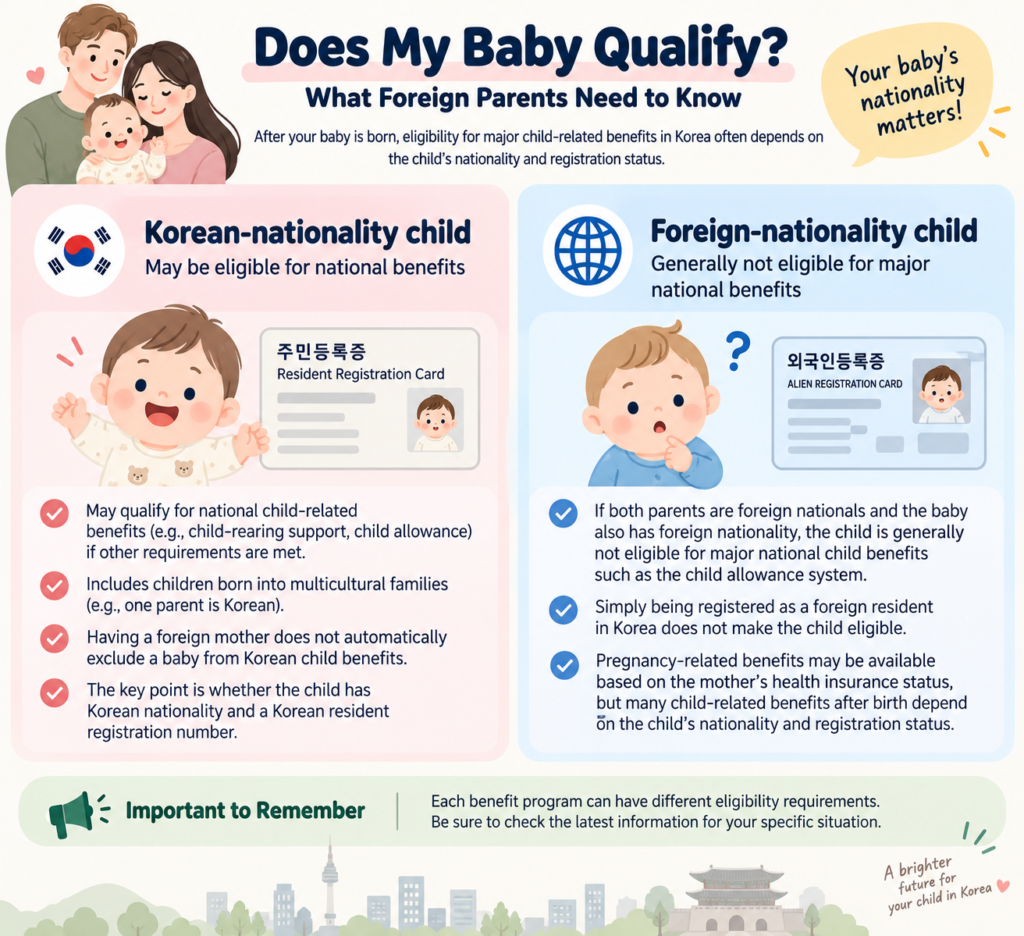
Does My Baby Qualify? What Foreign Parents Need to Know
This is where things can become more complicated.
After your baby is born, the eligibility rules for major child-related benefits can depend on the child’s nationality and registration status.
🇰🇷 If Your Baby Has Korean Nationality
If your baby has Korean nationality and receives a Korean resident registration number, the child may qualify for national child-related benefits if the other requirements are met.
This can include children born into multicultural families where one parent is Korean.
So, having a foreign mother does not automatically exclude a baby from Korean child benefits.
The important point is whether the child meets the nationality and registration requirements of the relevant benefit.
🌎 If Both Parents Are Foreign Nationals
If both parents are foreign nationals and the baby also has foreign nationality, simply being registered as a foreign resident in Korea generally does not make the child eligible for major national child benefits such as the current child allowance system.
This is an important distinction for foreign families living in Seoul.
Pregnancy benefits may be available based on the mother’s health insurance status, while many child-related benefits after birth depend on the child’s nationality and registration status.
What About Childcare Fees?
Childcare support can have separate rules from cash benefits such as child allowances.
For Korean-nationality children with Korean resident registration, national childcare support can be provided when the child meets the relevant requirements.
For foreign-nationality children who only have foreign resident registration, national childcare support does not generally apply in the same way.
However, some local governments provide separate childcare support for foreign children.
This means that if your child has foreign nationality, it is worth checking your local government’s policies rather than assuming that you are either fully eligible or completely excluded from all support.
So, What Is Actually Changing in 2027?
Now, let’s look at the reform that has been making headlines.
The Korean government has proposed restructuring several existing child-related benefits.
Under the proposal, the current:
- First Meeting Voucher
- Parental Benefit
- Child Allowance
would be reorganized into a new “Child-Rearing Support” (아이맞이지원금) system along with a new Basic Child Allowance (아동기본수당).
The proposed amount of the new child-rearing support is:
| Child | Proposed Support |
|---|---|
| First child | ₩10 million |
| Second child | ₩12 million |
| Third or later child | ₩15 million |
Families residing in officially designated priority areas—specifically Korea’s 89 designated “population decline areas” (인구감소지역) outside major metropolitan centers like Seoul—could also receive an additional ₩5 million.
The proposed support would be paid in four installments during the child’s first year.
But there is one very important thing to remember:
These figures are part of the government’s 2027 proposal. They are not yet a finalized benefit that parents can apply for today.
So when you see headlines saying that a baby will receive “₩10 million” or “₩12 million,” it does not mean that this amount is currently being paid to every baby born in Korea.
It is also important to understand that the proposed ₩10–15 million is not simply an additional payment on top of every existing benefit. The reform would reorganize several existing child-related benefits into a new system.
Why July 1, 2027 Matters
Under the current government proposal, the new system would apply to babies born from July 1, 2027.
That creates an unusual situation.
Imagine two babies:
Baby A
Born June 30, 2027
→ Existing benefit system
Baby B
Born July 1, 2027
→ Proposed new benefit system
The babies would be born just one day apart, but under the current proposal, they could fall under different benefit systems.
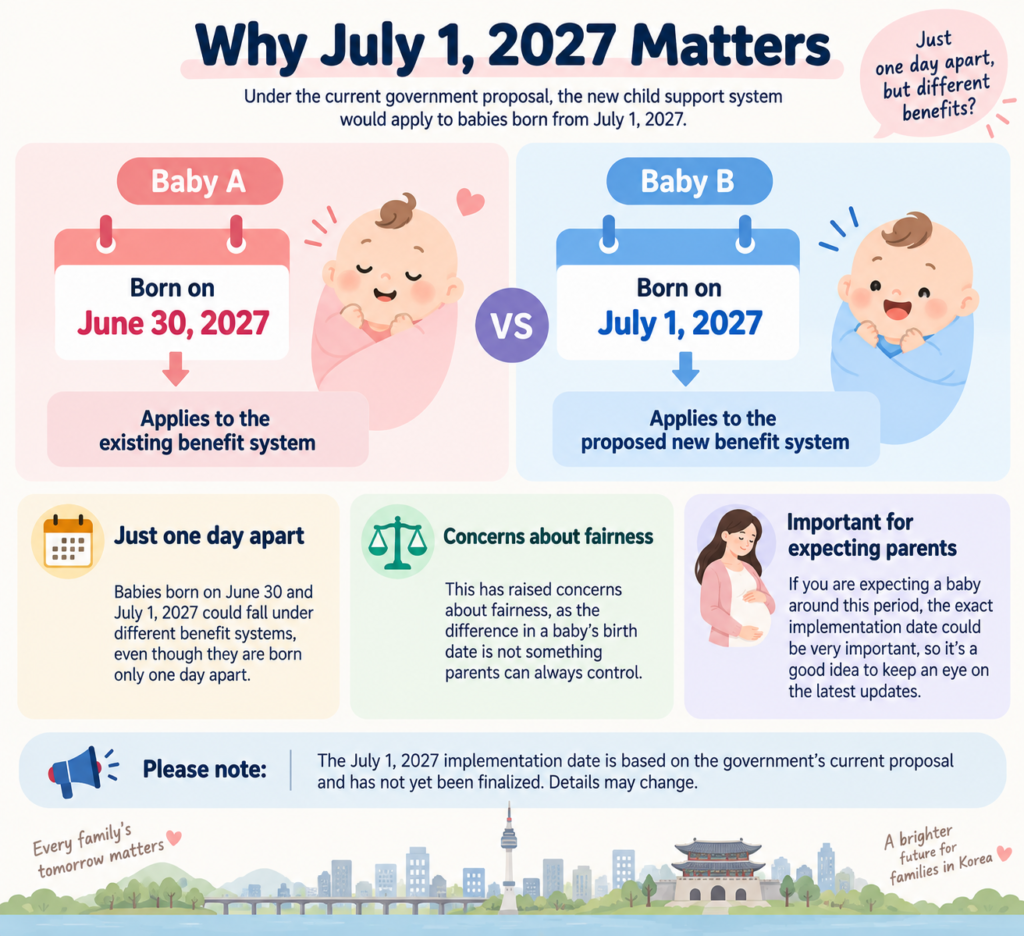
This has led to concerns about fairness, especially because the difference in a baby’s birth date is not something parents can always control.
For families expecting a baby around this period, the exact implementation date could therefore be very important.
Could the New Benefits Be Applied From January 1, 2027?
Because of the concerns about the July 1 cutoff, the government is also considering whether the new benefits could be applied retroactively to babies born from January 1, 2027.
Under this approach, the system itself could begin in July 2027, but babies born between January and June could also receive the new benefits retroactively.
However:
This has not been finalized.
Additional funding and the necessary legislative and budgetary procedures would be required.
So, as of September 2026, parents should not assume that every baby born from January 1, 2027 will automatically receive the new benefits.
The July 1 cutoff remains part of the current proposal, while January 1 retroactive application is still under review.
What Should Foreign Parents Check Before Having a Baby in Seoul?
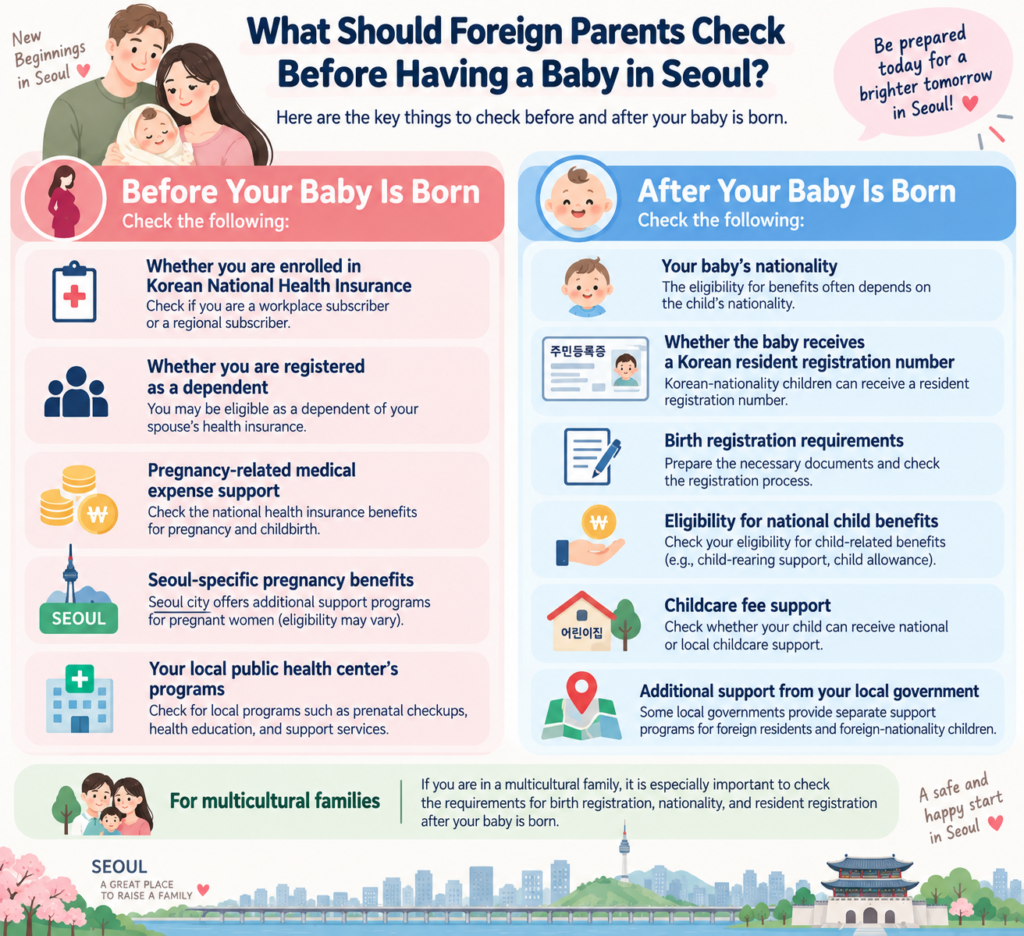
If you are a foreign parent living in Seoul, there are a few things worth checking separately.
Before your baby is born
Check:
- Whether you are enrolled in Korean National Health Insurance
- Whether you are registered as a dependent
- Pregnancy-related medical expense support
- Seoul-specific pregnancy benefits
- Your local public health center’s programs
After your baby is born
Check:
- Your baby’s nationality
- Whether the baby receives a Korean resident registration number
- Birth registration requirements
- Eligibility for national child benefits
- Childcare fee support
- Additional support provided by your local government
For multicultural families, it is particularly important to check the requirements for birth registration, nationality, and resident registration after the baby is born.
Where Can Foreign Parents Find the Latest Information?
Because the 2027 reform is still being finalized, information can change.
For the latest information, check official Korean government and Seoul sources such as:
- Mongttang Information (몽땅정보통) — Seoul’s integrated information platform for pregnancy, childbirth, and parenting support
- Government24 — government services and administrative information
- Bokjiro — Korea’s welfare information portal
- Your local community service center (주민센터)
- Your local public health center (보건소)
If you are a foreign resident, it can also be useful to check information provided by the Seoul Foreign Resident Center (서울외국인주민센터) / Seoul Foreign Portal (서울외국인포털), especially for programs specifically available to foreign residents.
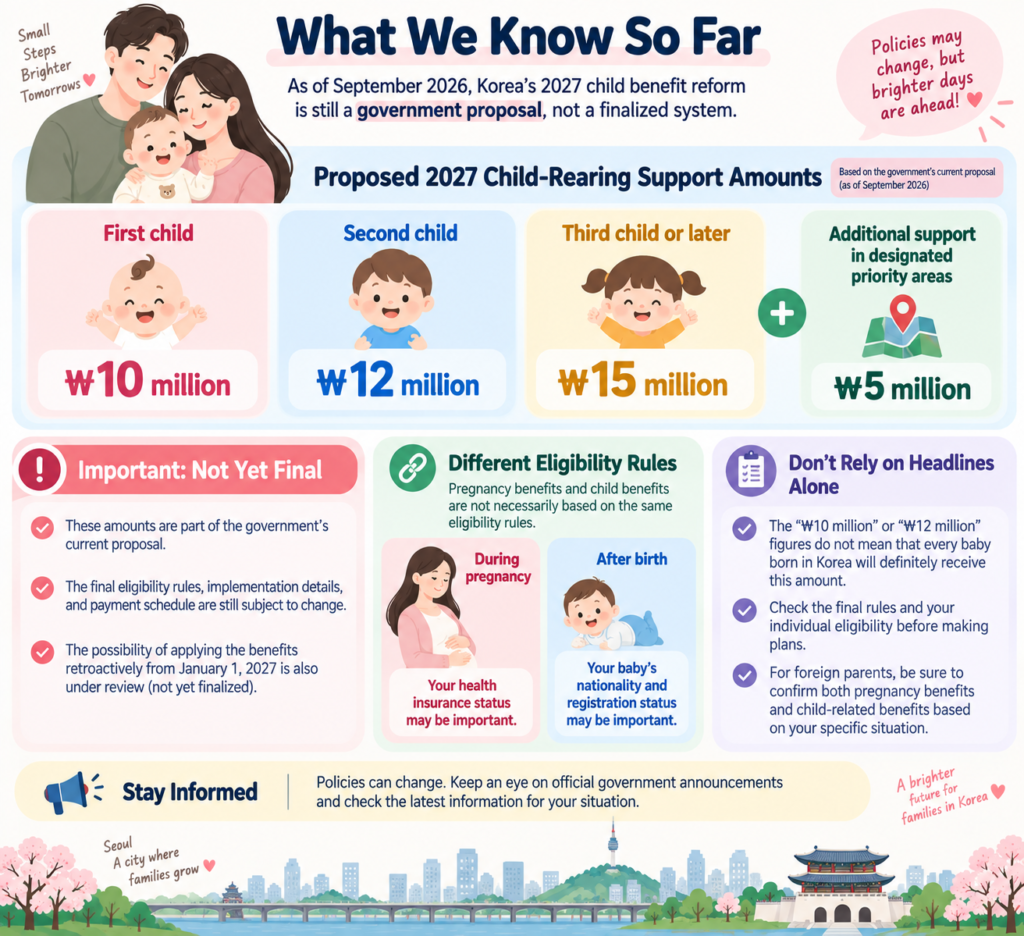
What We Know So Far
As of September 2026, Korea’s 2027 child benefit reform is still a government proposal, not a finalized system.
The proposed changes would provide:
- ₩10 million for a first child
- ₩12 million for a second child
- ₩15 million for a third or later child
- An additional ₩5 million in designated priority areas
But the final eligibility rules, implementation details, and the possibility of applying the benefits retroactively from January 1, 2027 are still subject to change.
For foreign parents, there is one especially important distinction to remember:
Pregnancy benefits and child benefits are not necessarily based on the same eligibility rules.
Your health insurance status can be important during pregnancy, while your baby’s nationality and registration status can become important after birth.
So if you are expecting a baby in Seoul in 2027, don’t rely on the “₩10 million” or “₩12 million” headline alone. Check the specific requirements for your health insurance and your child’s nationality, and keep an eye out for final government updates.
Leave a Reply