
A Korean Local’s Perspective on a Familiar Word That Means More Than Just “Aunt”
If you spend time in Korea, especially around young children, you might hear the word imo (이모) surprisingly often.
Children call their mother’s friends imo. A close friend’s child might call me imo, too. Parents sometimes refer to their babysitter as sitter imo or imo-nim, and at Korean restaurants, you might hear customers calling out, “Imo-nim!”
Parents even say things like:
“Did you find a sitter imo?”
“Is the sitter imo coming today?”
Wait a minute. Doesn’t imo simply mean your mother’s sister?
As a Korean, I’ve always found these expressions perfectly natural. But when I stop to think about it, I realize that we use this word in all kinds of relationships that have nothing to do with being related by blood.
So why do Koreans use imo so often?
I’d like to share my personal take on this familiar word and how I see it as a Korean mom.
1. First, What Do “Imo” and “Gomo” Mean?
In Korean, imo (이모) means your mother’s sister, while gomo (고모) means your father’s sister.
In English, both are called an aunt. Korean, however, has different terms depending on which side of the family the person belongs to.
So far, these are simply words that describe family relationships.
But in everyday Korean life, things get a little more interesting. You don’t have to be someone’s actual aunt to be called imo.
2. Your Mom’s Friend Might Be Your “Imo”
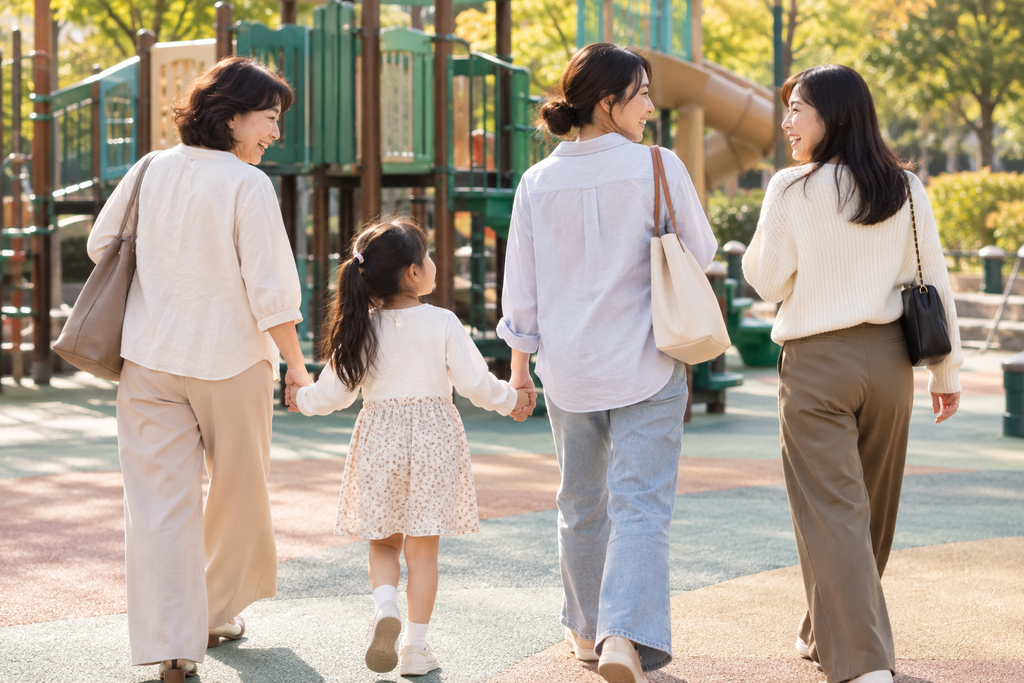
In Korea, children often call their mother’s close female friends imo.
And it goes both ways. If I’m close friends with another mother, her child might call me imo, too.
Of course, I’m not actually the child’s maternal aunt. Yet the title feels perfectly natural.
Perhaps the connection between the mother and her friend extends to the child as well.
If someone is a close friend of your mom, that person may also become a familiar and trusted adult in your life. Calling her imo is an easy, natural way to reflect that closeness.
You might notice something similar among children at daycare or kindergarten. A child may call the mother of a friend from daycare or kindergarten imo. Depending on the situation, they might also call her ajumma (아줌마), a term used for an adult woman that can sometimes sound too blunt or impolite, depending on the context.
Of course, not every child uses these terms. Some call their friend’s mother by her child’s name plus eomma (엄마, meaning “mom”), or use another form of address.
To me, these examples show how imo can be used beyond its literal family meaning.
3. Even Babysitters Can Be Called “Imo-nim”
One expression I find particularly interesting is sitter imo-nim (시터 이모님).
In Korea, some families refer to their babysitter as sitter imo (시터 이모) or imo-nim (이모님).
You might even hear Korean parents ask each other:
“Did you find a sitter imo?”
“Is the sitter imo coming today?”
The babysitter isn’t actually a relative. Caring for children is their job, yet a family term is often used to address them.
Not every family uses this expression, of course. People have different preferences for how they address their childcare providers.
Still, I find the choice of words interesting.
The word babysitter describes the person’s role or job. Calling someone imo-nim, on the other hand, can feel a little more personal and familiar.
A quick language note: imo means “maternal aunt,” while -nim is a Korean honorific suffix added to a name or title to show respect. It doesn’t have an exact English equivalent. In this expression, it adds a respectful tone to the familiar word imo.
My impression is that the title can make a childcare relationship feel a little more personal, rather than purely professional.
At least, that’s how the expression feels to me.

4. You Might Hear It at Korean Restaurants, Too
The word imo isn’t used only in childcare situations.
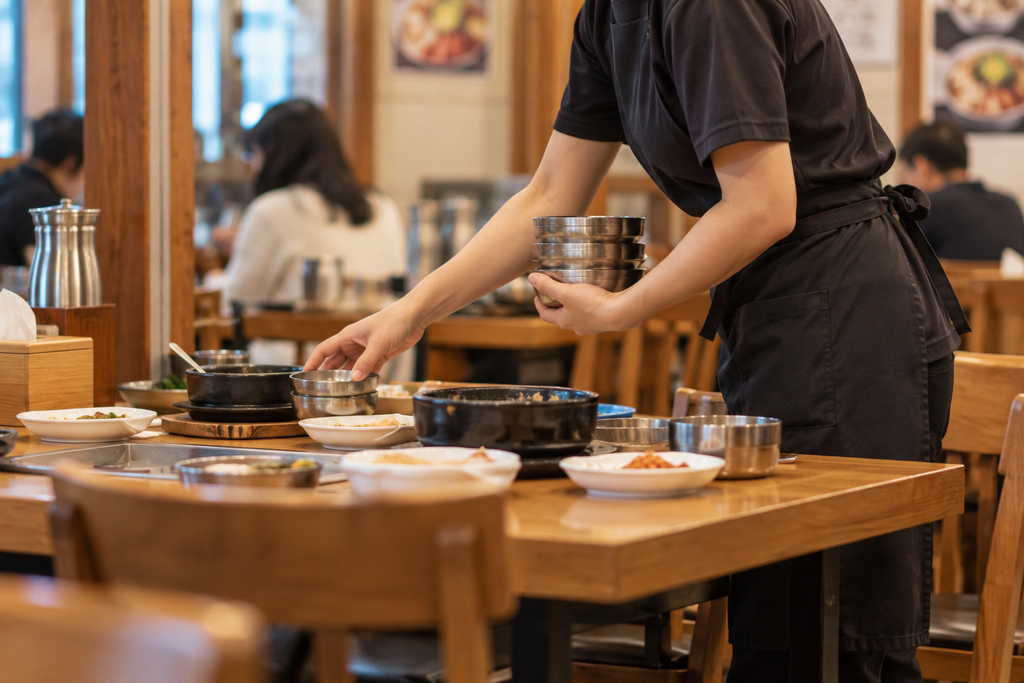
At Korean restaurants, customers sometimes call female staff members imo or imo-nim.
They aren’t relatives, of course. They’re customers and staff members. Yet a family term sometimes becomes a familiar way to address someone in an everyday setting.
Why use the word imo?
I don’t have a definitive answer, but as a Korean, I’ve noticed that the word can feel warm and approachable.
It can be used to get someone’s attention in a relatively casual, friendly atmosphere, even when the customer and the staff member don’t know each other personally.
Adding -nim makes the expression more respectful while keeping the familiar feeling of imo.
That said, imo-nim isn’t appropriate in every situation, and not everyone may be comfortable being addressed that way. The most natural form of address depends on the setting and the people involved.
Still, I find it interesting that a word for a family member can also appear in such an ordinary public setting.
5. So Why “Imo” in Particular? My Personal Theory
From this point on, I’m sharing my own interpretation rather than an established explanation of the word’s origins.
Why has imo, rather than gomo, become such a familiar term in these different relationships?
One possible clue, in my view, lies in what imo means in the first place.
An imo is your mother’s sister. She is part of your mother’s family and may also be someone who feels familiar and affectionate to you as a child.
Calling your mother’s friend imo makes sense to me in this context. The title connects someone close to your mom with someone who can also be a familiar adult in your life.
But I wonder whether that association has extended beyond the family.
When a family calls its babysitter imo-nim, perhaps the word brings some of that same sense of closeness into a relationship built around caring for a child.
I also wonder whether traditional expectations around women and caregiving play a role. In Korea, childcare and housework have historically been strongly associated with women, and imo is a term for a female family member. Perhaps this has made it feel like a natural choice in certain caregiving situations.
I can’t say that this is the historical reason the word developed this way. People may use imo for different reasons, and I don’t have evidence that all Koreans share the same associations.
I also sometimes feel that imo carries a warmer, more nurturing image than gomo in certain everyday contexts. That’s simply my personal impression, though, not a universal Korean perception.
To me, imo can suggest more than a specific family relationship. Depending on the situation, it can also bring to mind familiarity, warmth, and care.
That’s how I understand the word as a Korean.
6. More Than Just a Family Title
In Korean, imo literally means your mother’s sister.
But in everyday life, the word can also be used for a mother’s friend, by a friend’s child, for a babysitter, and sometimes for a female restaurant worker.
Of course, this doesn’t mean that every woman is called imo, or that the term is appropriate for everyone. The most natural form of address depends on the people and the situation.
Still, to me, imo can do more than identify a family relationship. It can also express a sense of familiarity.
If you’re learning Korean, you might initially wonder why a word for a maternal aunt is used for people who aren’t related to you at all.
But once you spend more time in Korea, you may notice that everyday language often goes beyond dictionary definitions.
I think that’s one of the interesting things about Korean language and culture: sometimes, a word tells you not only who someone is, but also how people relate to one another.
Now I’m curious: Does your language have a word for an aunt that people also use for friends, caregivers, or people outside the family?
Do you use family terms for your friends’ parents, people who look after your children, or even people you don’t know very well?
I’d love to know how people express these relationships in your culture, too.
Leave a Reply