If you’re a foreign parent raising a child in Korea, you may find the Korean daycare system a little confusing at first.
What exactly is the difference between daycare and kindergarten? How does enrollment work? How much does it cost? And what is everyday life at a Korean daycare actually like?
I’m a Korean parent, and my toddler has been attending a home-based daycare (가정어린이집) since she was about one year old. So rather than giving you a purely official explanation, I wanted to share what I’ve learned from actually using the system.
Here is a practical introduction to daycare in Korea, from a Korean parent who has been living it.
Daycare in Korea: What Exactly Is It?
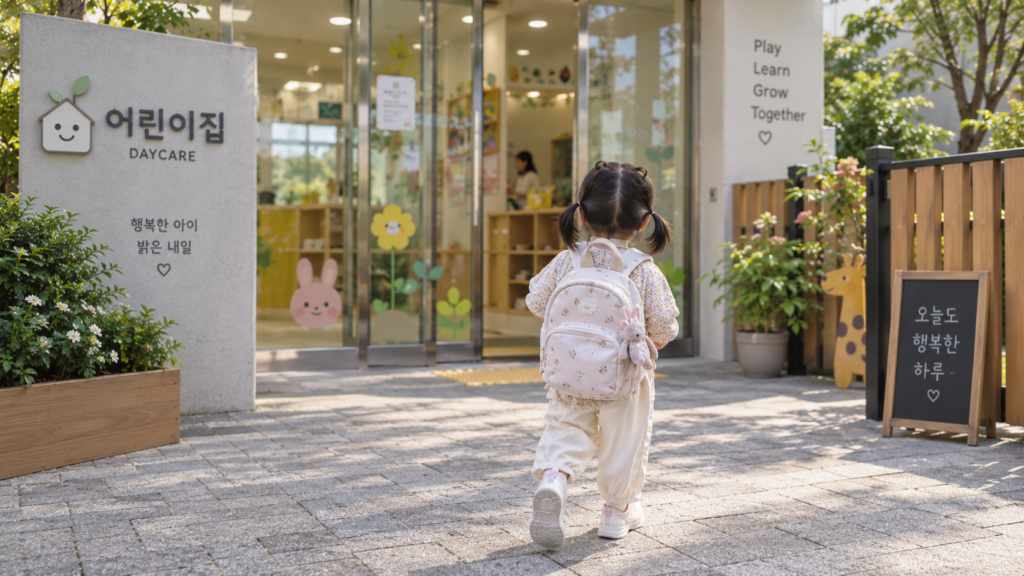
In Korea, daycare (어린이집, eorinijip) is for children from infancy through the preschool years. Kids can start daycare when they’re babies, and depending on the type of center, they may stay until the year before they start elementary school. If parents have difficulty caring for their child due to reasons like dual incomes, children may attend from less than a year old.
You’ll come across several different types of daycare centers:
- Public/national daycare (국공립 어린이집)
- Private daycare (민간 어린이집)
- Home-based daycare (가정 어린이집)
- Workplace daycare (직장 어린이집)
I chose a home-based daycare for my toddler. These centers are usually much smaller than large public or private daycares, so the atmosphere can feel quite different.
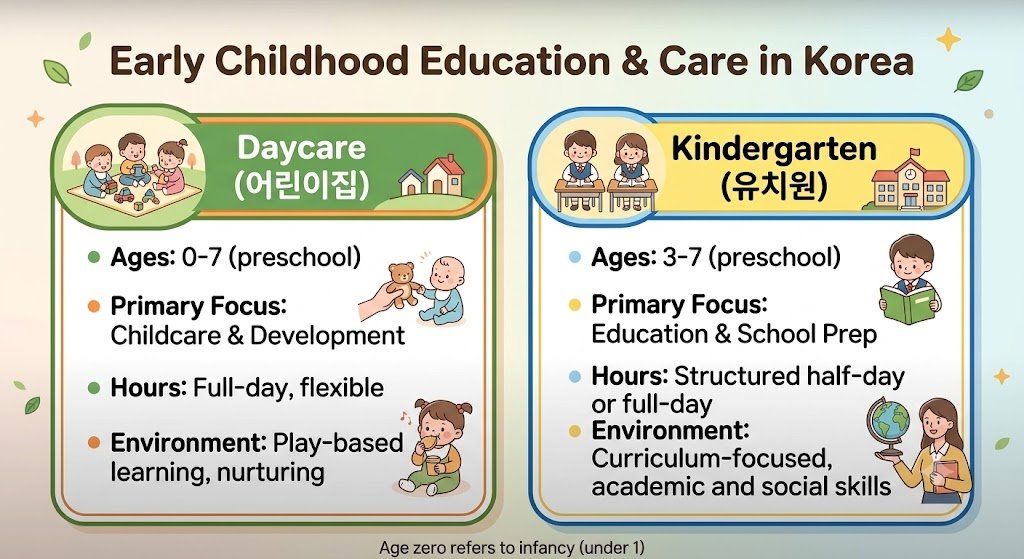
One thing that often confuses foreign parents is that daycare and kindergarten are separate systems in Korea.
Daycare generally serves children from 0 to 5, while kindergarten generally serves children from 3 to 5. Korea is also working toward integrating the two systems, so some of the administrative rules are changing.
So what’s the practical difference?
Daycare can start from infancy and combines childcare with play, development, meals, naps, and early learning.
Kindergarten generally starts at age 3 and has a more school-like educational structure.
That said, the line isn’t as simple as “daycare is for care, kindergarten is for education.” There is plenty of learning at daycare too, and the actual experience depends a lot on the individual center.
When you’re comparing centers, I’d look at the daily schedule, location, class size, program, and overall atmosphere, rather than focusing only on whether it’s technically a daycare or kindergarten.
How Do You Get a Spot in a Korean Daycare?
This was one of the first things I learned as a parent:
It’s worth starting your search early.
Parents can use Korea’s i-Sarang childcare portal (아이사랑) to search for daycare centers and apply for waiting lists. Seoul also has its own childcare information system.
And admission isn’t simply first come, first served.
There are priority categories under Korea’s childcare system, so some families are given priority over others. For example, certain low-income households, single-parent families, children with disabilities, and children who already have a sibling at the same center may receive priority.
Popular centers can fill up quickly, so I wouldn’t wait until the last minute if you already know roughly when your child will need daycare.
What about foreign children?
This is something I’d check separately rather than assuming the rules are exactly the same.
For example, Seoul has a 2026 childcare-fee support program for eligible foreign children attending daycare in Seoul. The amount of support depends on the child’s age and the type of daycare, and the program has its own eligibility requirements.
So if you’re a foreign parent, check the current rules for the city or district where you live. Support can vary by location, and nationality or residence status can affect eligibility.
How Much Does Daycare Cost in Korea?
This is probably one of the first things foreign parents want to know.
For 2026, the standard government-supported daycare fee is:
| Age | Monthly childcare fee |
| 0 years old | ₩584,000 |
| 1 year old | ₩515,000 |
| 2 years old | ₩426,000 |
| 3–5 years old | ₩280,000 |
For eligible children, these basic childcare fees are covered through government support.
But there’s an important catch:
“Free daycare” doesn’t necessarily mean you will never pay anything.
Depending on the center and your local government, there may still be additional costs for things like special activities, field trips, transportation, clothing, or other approved expenses. The exact amount can vary from one daycare to another.
And again, foreign children may have different support depending on where they live and what they qualify for.
So before enrolling, I’d ask the daycare for a clear breakdown of what is covered and what parents actually pay.
What About Childcare Allowances?
Korea also has several government programs that provide financial support for families with young children.
For eligible children under age 2, the parental benefit (부모급여) is currently ₩1,000,000 per month for children under age 1 and ₩500,000 for children aged 1. The way the benefit is provided can depend on whether the child is using daycare.
There are also other child-related benefits, including child allowance and home-care support.
This part of the Korean system can get confusing quickly, especially because the programs have different eligibility rules.
If you’re a foreign parent, I would check the latest official guidance rather than relying on an older blog post or information from another family.
How Long Is a Daycare Day?
Korean daycare centers are designed with working families in mind, so the hours are often longer than parents from other countries might expect.
The standard operating framework runs from 7:30 AM to 7:30 PM on weekdays, with basic childcare generally taking place from around 9:00 AM to 4:00 PM and extended care available for children who need it.
Of course, your child’s actual schedule will depend on the daycare.
Some children go home after the basic childcare period, while others stay for extended care until their parents finish work.
For working parents, that flexibility can make a big difference.
What Is Everyday Life Like?
This is actually the part I find most interesting.
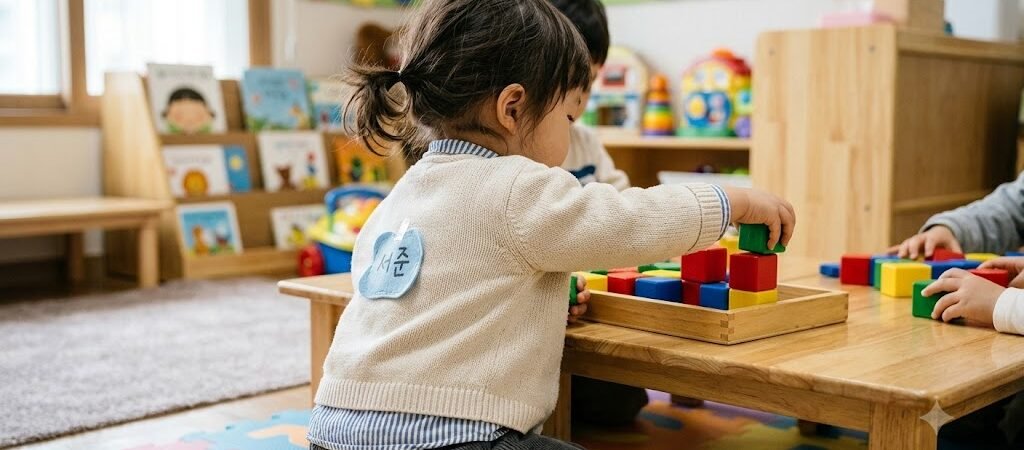
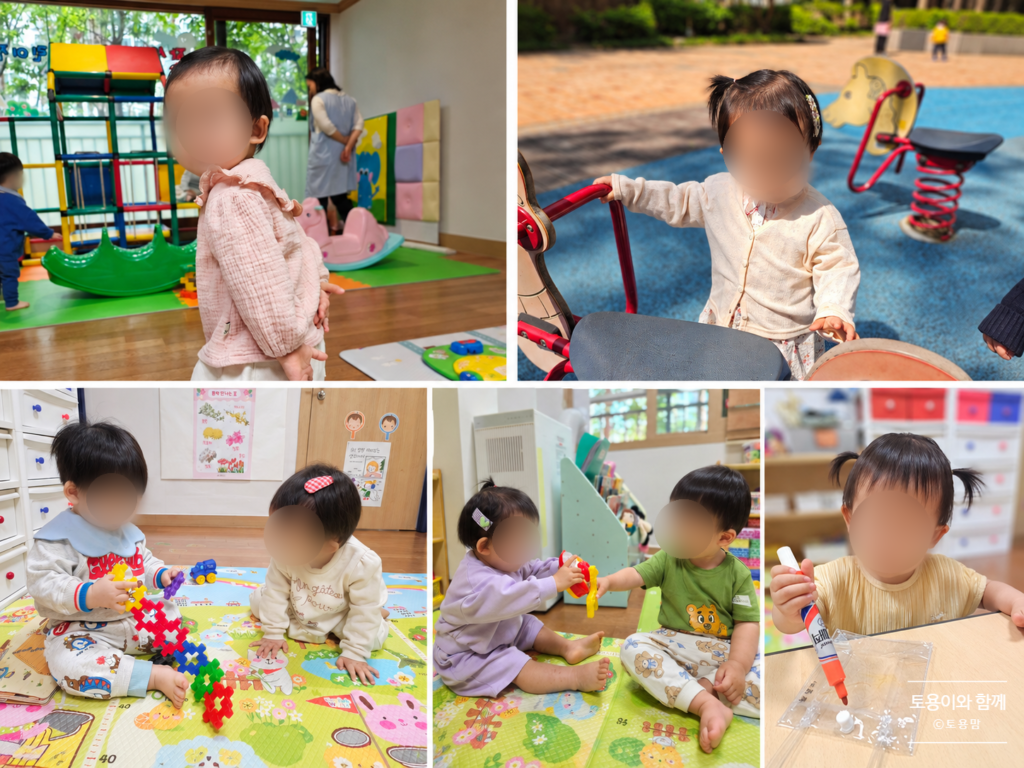
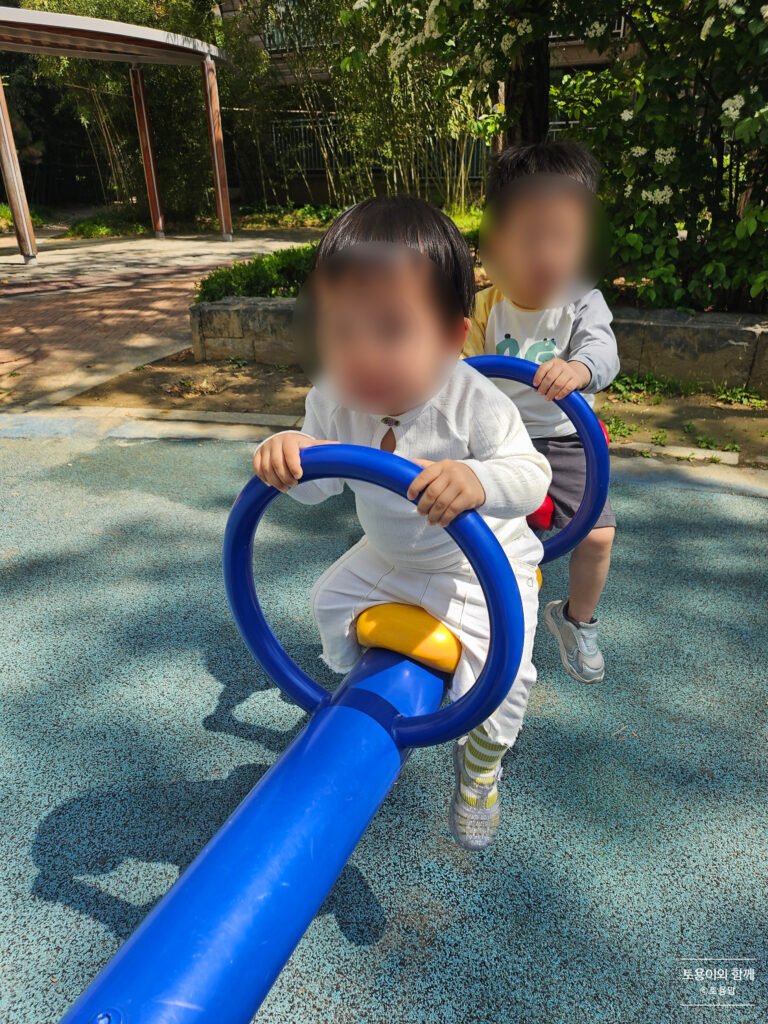
A typical daycare day can include meals, snacks, naps, free play, outdoor time, music, art, story time, physical activities, and seasonal events. Exactly what they do depends on the age group and the individual center.
And parents often get a surprisingly detailed update at the end of the day.
Enter: KidsNote 📱
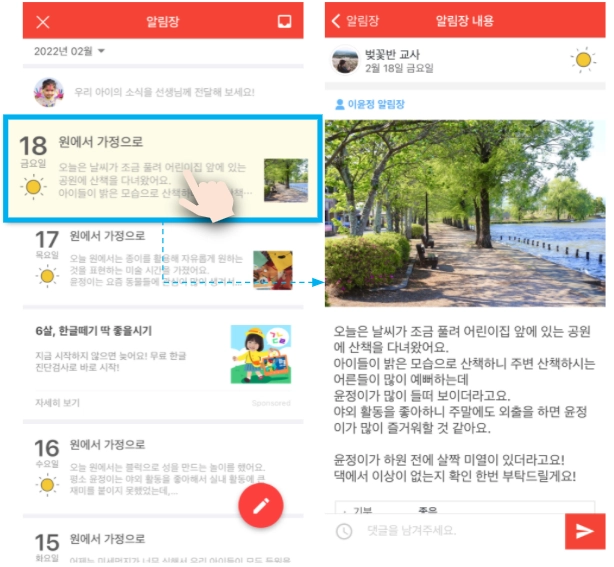
Many Korean daycare centers use KidsNote to communicate with parents.
Depending on the daycare, you might get updates about:
- what your child ate
- how long they slept
- what they did that day
- their mood or condition
- photos from activities
- announcements from the daycare
As a parent, it can feel like getting a tiny daily report on your toddler.
Sometimes I open the app and think, “Okay… apparently she had a very busy day.” 😂
A Few Things That Surprised Me as a Parent
The practical side of daycare is important, but some of my favorite memories have nothing to do with schedules or paperwork.
My toddler became the “class leader”
My toddler was only about one year old when her teachers started calling her the “class leader.”
Apparently, she was the child the other kids naturally gravitated toward.
It has been so much fun watching these little personalities develop. Some are quiet, some are energetic, and some seem ready to run the whole classroom. 😂
Seeing those little friendships develop is one of the things I didn’t expect to enjoy so much about daycare.
And Then There Was Kimjang
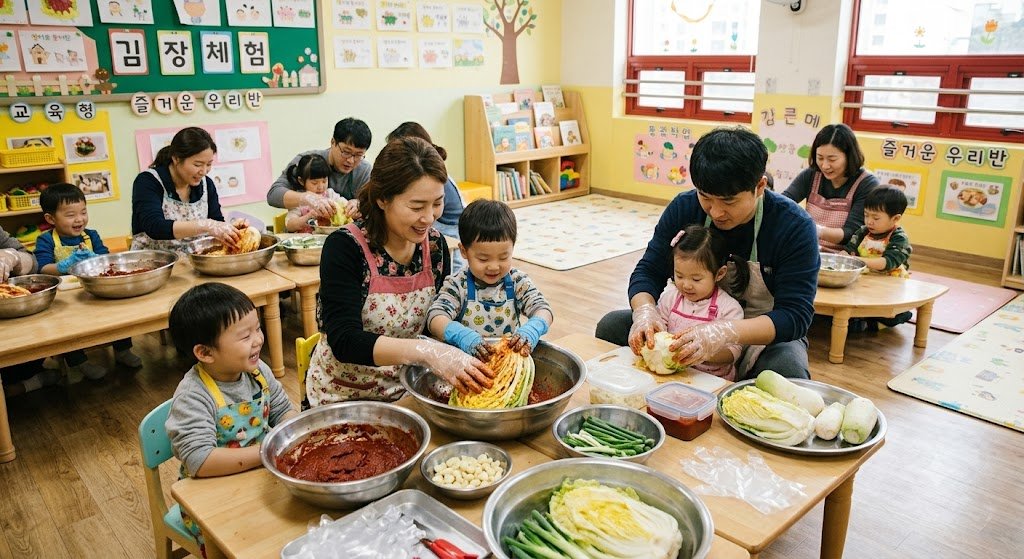
A few times a year, parents may also be invited to join special activities at daycare.
One of my favorites was kimjang, the Korean tradition of making kimchi.
The daycare turned it into a parent-and-child activity, giving the kids a chance to participate in their own little way while the adults handled most of the actual work.
They obviously weren’t making a whole batch of kimchi themselves, but they could see the ingredients, get their hands involved, and experience the idea of making something together.
I loved that daycare wasn’t just about getting through the day. It also gave my child a chance to experience little pieces of Korean culture.
Final Thoughts
Before becoming a daycare parent, I mostly thought of 어린이집 as a place where children stayed during the day while their parents worked.
After actually using the system, I see it a little differently.
The paperwork and enrollment process can feel complicated, especially when you’re trying to navigate it in another language. But day to day, daycare is also about meals, naps, play, friendships, seasonal activities, and all the little moments that become part of your child’s routine.
For foreign parents raising children in Korea, I hope this gives you a clearer picture of what daycare is really like.
And sometimes, you might even find yourself standing at a kimjang table with your toddler thinking:
“Well… this definitely wasn’t on my parenting bingo card.” 🇰🇷🥬
Leave a Reply